


Pros:
- The train ride from San Antonio was short.
- The Hampton Inn was secure and conveniently located.
- The Uber drivers were friendly and helpful.
- I was in science heaven—need I say more?
- I met the first mother in space.
Cons:
- I was concerned about going out alone after dark.
- The tour company was not fully informed about service-dog access.
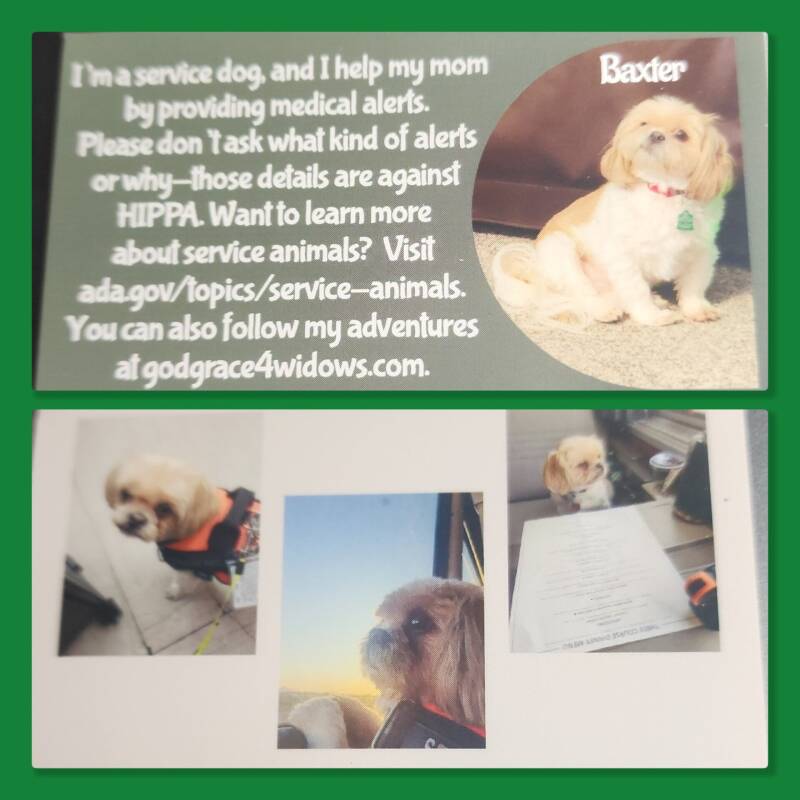
I was grateful to visit Houston and let my inner science geek run free. I met a young man from Germany and a young woman from England, and because we were the only solo travelers, we became tram buddies. Although I was unhappy that Baxter had to stay behind, God gave me a practical answer: carry business cards explaining that Baxter is a service dog, describing what he does, and linking to the relevant federal guidance and supporting website.
Houston, TX: May 15–17, 2026
Houston was not part of the trip John and I planned in 2024, but I could not pass up the opportunity to visit NASA. I admit it: if an attraction involves space, science, or astronomy, I want to be there. Because the May 15 trip from San Antonio was only about four and a half hours and departed at 6:25 a.m., I also planned to visit the Houston Museum of Natural Science and the Cockrell Butterfly Center that afternoon.
My Uber driver suggested stopping at Walmart on the way to the hotel to buy dinner for the next two nights. She advised me not to go out alone after dark and kindly helped me find everything quickly. Although the neighborhood looked safe, I understood that traveling alone at night could make me more vulnerable. At check-in, I asked about the museum and was told an afternoon visit would be fine as long as I returned before dark.
After settling in, I took an Uber to the museum. A typical visit takes two to four hours. Highlights included:
- Permanent Exhibits: Four floors featuring dinosaurs, gems and minerals, ancient Egypt, and much more.
- Cockrell Butterfly Center: A three-story glass habitat with a simulated rainforest, exotic plants, more than 1,500 colorful butterflies, and a 50-foot waterfall. Butterflies fluttered around us, sipped nectar, and even landed on visitors.
- Burke Baker Planetarium: Since opening in 1964, the planetarium has introduced millions of visitors to astronomy. The program let us explore the universe, cross planetary surfaces, and navigate asteroid fields.
Saturday, May 16, 2026
NASA was my second-favorite adventure of the entire trip. After breakfast at the Hampton Inn, I received a call from the tour office saying Baxter could not come. I explained that he is a service dog, not a pet, but the caller remained adamant, so I reluctantly left Baxter at the hotel. When I boarded the van, another employee asked where he was and confirmed that he had been allowed to join the tour. By then it was too late. I replied politely that the employee who called me needed additional training.
Astroville NASA Private Tour: The tour combined round-trip transportation from downtown Houston with admission to Space Center Houston, solving the challenge of the 45-to-60-minute trip from the Bank of America Tower. Including sightseeing, the experience lasted about eight hours.
We were especially fortunate to have a guide who had grown up on NASA property. Her father worked on Apollo 11 and many other projects, giving her a wealth of knowledge and memorable stories. Highlights included:
- Independence Plaza: The only place where visitors can enter a high-fidelity space shuttle replica mounted atop the original NASA 905 Boeing 747 Shuttle Carrier Aircraft.
- International Space Station: Exhibits explained how the orbiting laboratory travels about 250 miles above Earth at roughly 17,500 miles per hour, completing an orbit about every 90 minutes. Continuously occupied since November 2, 2000, it is operated by NASA, Roscosmos, ESA, JAXA, and CSA and generally supports a seven-member crew conducting research, maintenance, and technology demonstrations. NASA’s Spot the Station resources allow the public to track it.
- Mission Mars: This exhibit traced humanity’s changing understanding of Mars and NASA’s plans for future exploration. I touched a real piece of Mars, viewed rare meteorites, and explored a rocket-engine inspection station.
- Artemis: An interactive look at NASA’s program to return humans to the Moon.
- Starship Gallery and Spacesuit Collection: Flown spacecraft, national treasures, and spacesuits traced the history of human space exploration. One highlight was the ejection suit John Young wore on the first shuttle flight in 1981.
- NASA Tram Tours: Offered a close look at Johnson Space Center, NASA’s astronaut-training base and home of Mission Control. Stops and views included Historic Mission Control, the Astronaut Training Facility, campus research facilities, and George W. S. Abbey Rocket Park, home to a Saturn V rocket.
- The Moonwalkers: A Journey with Tom Hanks brought lunar exploration to life.
- Anna Lee Fisher: The first mother in space gave a captivating 20-minute talk that held my full attention.